The timber calculations reviewed in the timber design pages on this website are based on BS EN 5288 Part 2. This standards includes modification factors used to allow for operating conditions and loading scenarios. This page provides some guidance in assessing these factors
Relevant Standards..For comprehensive list of standards Wood related Standards
BS 5268 -2 ;2002 Structural use of timber — Part 2: Code of practice for permissible stress design, materials and workmanship.
Modifying factors
|
K2 by which stresses and moduli for service classes 1 and 2 should be multiplied to obtain stresses and modulii applicable to service class 3 K3 for duration of loading K4 for bearing stress K5 for notched beams K6 for shapes other than rectangular K7 width factor for bending stresses for widths other than 300mm K8 for load sharing applications K9 used to modify the minimum modulus of elasticity for trimmer joists and lintels K12 for compression members K13 for the effective length of spaced columns K14 width factor for tensile loaded members for widths other than 300mm K15, K16, K17, K18, K19 and K20 for single grade glued laminated members and horizontally K27, K28 and K29 for vertically glued laminated members K30, K31 and K32 for individually designed glued end joints in horizontally glued laminated members |
K2
Modification factor, K2, by which stresses and moduli for service classes 1 and 2 should be multiplied to obtain stresses and moduli applicable to service class 3.
Note:.. The properties provided in BS 5368:2007 for the different timbers are generally applicable to Service class 1 & 2. Please refer to notes on service class Service Class
| Property | Value of K2 |
| Bending parallel to grain | 0,8 |
| Tension parallel to grain | 0,8 |
| Compression paralle to grain | 0,6 |
| Compression parallel to grain | 0,6 |
| Shear parallel to grain | 0,9 |
| Mean & Min Modulus of Elasticiy | 0,8 |
K3
| Duration of Load | Value of K3 |
| Long Term (e.g.permanently imposed ) | 1,00 |
| Medium term (e.g. dead + temporary imposed | 1,25 |
| Short Term (e.g. dead + imposed + wind | 1,5 |
| Very short term (e.g. dead + wind | 1,75 |
K4
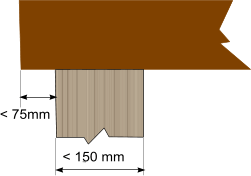
The grade stresses for compression perpendicular to the grain apply to bearings of any length at the ends of a member, and bearings 150 mm or more in length at any position. However for bearings less than 150 mm long located 75 mm or more from the end of a member, as shown in figure belwo thee grade stress should be multiplied by the modification factor, K4
| length of Bearing | Value of K4 |
| 10 | 1,74 |
| 15 | 1,67 |
| 25 | 1,53 |
| 40 | 1,33 |
| 50 | 1,20 |
| 75 | 1,14 |
| 100 | 1,10 |
| 150+ | 1,00 |
K5
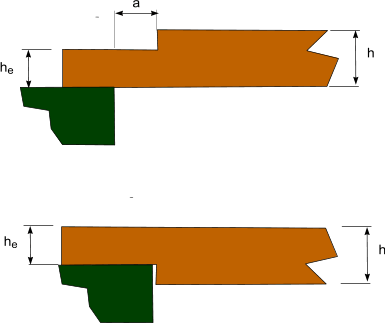
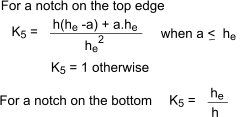
This factor is applied for members taking load at notched ends as shown below
K6
Grade bending stresses primarily apply to solid timber members of rectangular cross-section. For other shapes of cross-section the grade bending stresses should be multiplied by the modification factor, K6, where
| K6 = 1.18 for solid circular sections; K6 = 1.41 for solid square sections loaded on a diagonal. |
K7
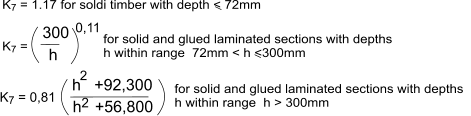
The grade bending stresses provided in the tables is generally based on sections 300mm deep a constant (K7)is used when other thicknesses are used.
K8
In construction applications where four or more members are sharing the imposed load e.g. rafters , joists, trusses etc. with suitable provisions for distributing the load e.g. boarding, battens etc the admissibles stresses and the modulus shoul be obtained using the following rules .
|
K9
The members which are sharing the load, as described above, the minimum modulus of elasticity hould be modified by the factor, K9, when calculating the deflection deflections
| No Pieces | Value of K9 | |
| Softwoods | Hardwoods | |
| 1 | 1,00 | 1,00 |
| 2 | 1,14 | 1,06 |
| 3 | 1,21 | 1,08 |
| 4 or more | 1,24 | 1,10 |
K14
The grade compressive stress listed in the tables are based on a width of 300mm. For timber members of other sizes a factor K14 should be used.
K14 = 1,17 for solid timber with a width less than 72mm
K14 = (300 h.)0,11 for solid members having a width h greater than 72mm
K15,K16,K17K18,K19,K19
Modifcation factors for horizontally glued single grade laminates
| Strength Class | Number of Laminations | Bending Parallel to Grain |
Tension parallel to grain | Compression parallel to grain | Compression normal to grain | Shear parallel to grain> | Modulus of Elasticity |
| K15 | K16 | K17 | K18 | K19 | K20 | ||
| C27,C30,C35, C40 D50,D60,D70 |
4 or More | 1,1 | 1,1 | 1,04 | 1,49 | 1,49 | 1,00 |
| C16,C18,C22, C24 D30,D35,D40 |
4 | 1,26 | 1,26 | 1,04 | 1,55 | 2,34 | 1,07 |
| 5 | 1,34 | 1,34 | |||||
| 7 | 1,39 | 1,39 | |||||
| 10 or more | 1,42 | 1,42 |
K27,K28,K29
Modification factors for vertically glued single grade laminates
| Number of laminations | Bending, Tension and shear parallel to grain K27 |
Mod of elasticity and compression parallel to grain K28 |
Compression normal to grain K29 |
||
| Softwoods | Hardwoods | Softwoods | Hardwoods | Softwoods and Hardwoods | |
| 2 | 1,11 | 1,06 | 1,14 | 1,06 | 1,10 |
| 3 | 1,16 | 1,08 | 1,21 | 1,08 | 1,10 |
| 4 | 1,19 | 1,10 | 1,24 | 1,10 | 1,10 |
| 5 | 1,21 | 1,11 | 1,27 | 1,11 | 1,10 |
| 6 | 1,23 | 1,12 | 1,29 | 1,12 | 1,10 |
| 7 | 1,24 | 1,12 | 1,30 | 1,12 | 1,10 |
K30,K31,K32
| Timber | Bending, parallel to grain | Tension, parallel to grain | Compression, parallel to grain |
| K28 | K31 | K32 | |
| Softwood | 1,63 | 1,63 | 1,43 |
| Hardwood | 1,32 | 1,32 | 1,42 |