The Disk Clutch is used to transmit torque from an input to an output shaft via circular plates (disks). One of each pair of plates is coated with a friction lining material. The force applied to the friction element may be manual, electrical, pneumatic, hydraulic or inertial via a mechanical linkage. As the input and output shafts are fixed the clutch should include a method of allowing the driving plates to move axially against the driven plates which are fixed to the driven shaft (or vice versa).
A selection of disk clutch plate materials with their important properties are provided on page Brake/Clutch materials
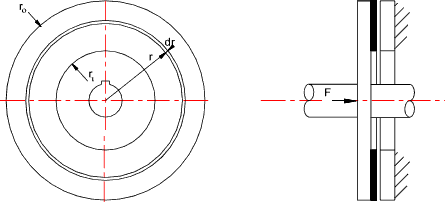
| F = Applied Force (N) P = Clutch transmitted Power kW M = Torque (Nm) F = Actuating Force (N) μ = Coefficient of Friction. r = Radius of clutch ring thickness dr (m) r i, r o = Inner, Outer radius of clutch plate. (m) n = Rotational Speed (RPM) p = Pressure for friction surface(N/m2) p max = Maximum pressure for friction surface(N/m2) |
Theory
There are two operating conditions applicable to clutch plates
|
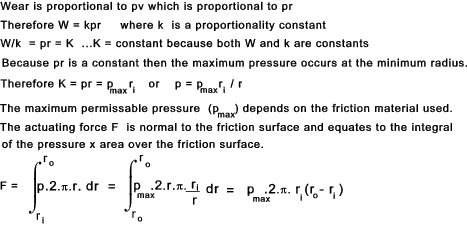
The wear (W)at any location on a cluthch is assumed to be proportional to the pressure intensity (p)and the associated relative velocity (v)of the local ring of contact.
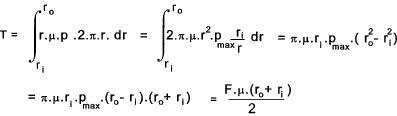
The torque capacity of a clutch plate is the integral of the friction force (μ F) x Radius (r)
Uniform pressure
When considering the capacity of a disk clutch plate subject uniform pressure, every point on the clutch plate face is subject to the the maximum design pressure for the friction material. This condition applies mainly to new clutch plates
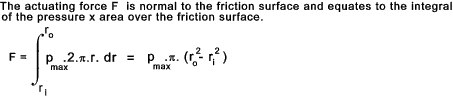
The torque capacity of a clutch plate is the integral of the friction force (μ F) x Radius (r)
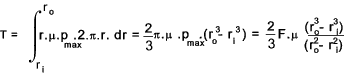
The above theory relates to single plate clutches. For multiple plates in contact the torque values should be multiplied by the number of contacting plates