A mechanism considered to be an assembly of mechanical items designed to achieve a specific purpose within a machine. There are clearly an infinite number of mechanisms available but the notes and links are concentrating on the specific ones as listed below. For specific information on linkages please refer.. Linkages
Motion Control Using Computers
The notes below relate generally to mechanical methods for providing relative motion and forces. There is an increasing tendency to produce motions using servo hydraulic systems and stepping motors under the control of digital computers. Although the mechanism design often requires creativity and a high level of analysis the final product is often low priced and provides reliable, efficient, predictable performance. However a mechanism is generally made to perform a fixed operation, reliably and predictably. Computer controlled motions can be continuously monitored and if necessary modified. If the output motion is changed from a harmonic motion to a periodic square wave motion or a sawtooth motion then changing the control parameters for a computer controlled system is often very convenient. If a large number of systems have been developed then the cost of modifying the software or firmware is much less than modifying a large number of mechanisms..
Although the motions of many of high technology machines and computer systems are being controlled by computers. The need for mechanisms is also increasing in consumer goods e.g. mechanisms in consumer goods, toys, lifting equipment, vehicles, aircraft, industrial machines, gardening implements,etc etc etc... ......
Classification Of Mechanisms
There are many methods of classifying mechanisms. The following list is a functional list based on the type of motion required. This list is based on that provided in Theory of Machines and Mechanisms ..Uicker, Pennock, ans Shigley. The notes below are low level descriptions. Over time additional notes will be included...For detailed analysis and synthesis please refer to the books listed in the book section of this site.
Snap Action Mechanisms
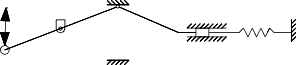
Snap action mechanisms are also called toggle and bi-stable mechanism are widely used for components for simple toggle switches to clamps. A typical toggle mechanism is shown below...
Linear Actuators
Stationary Screws with rotating nuts
This group include machine tool traversing mechanisms, jacks, valve drives etc etc.
These mechanism essentially convert rotary motion to linear motion. High mechanical advantages can result from components which are convenient to design and engineer. The output motions and forces are very easy to evaluate for the input forces.
Stationary Nuts with with rotating screw
This group includes power screw actuators, valve drives, jacks. The characteristics of this group is essentially the same as the group with stationary screws and rotating nuts
Single and double acting hydraulic and pneumatic cylinders
This is a massive group including positioning cylinders, rams jacks . The motions and forces are very easy to calculate..The motion involves convertion of potential energy in fluid to kinetic energy of the motion of the component moved by the cylinder
Fine adjustment mechanisms
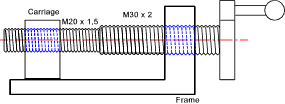
A fine adjusting mechanism is primarily used for control where small movements are required resulting from larger movements of the input. The variations of this group include screws, differential screws, gears, cams.etc etc. A typical method of providing small output rotations from input motions is shown below.. One rotation of the input shaft will result in a linear motion of the carriage of 0,5mm..
Clamping Mechanisms
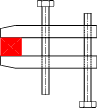
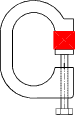
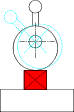
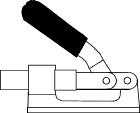
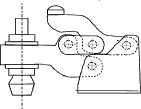
Typical clamping mechanisms include toolmakers clamps, G clamps, screw clamps, clamps based on cams. Clamps result from lever actions, screw forces, toggle motions..The two important factors in the engineering of a clamp is the method of applying a high force and the method of retaining the force after removal of the input motion...
|
|
|
|
|

|
|
|
Location Devices
Location devices often involve positioning and centralising of the component being located. Jigs and fixtures are used widely in industry for locating items prior to machining or assembly..
Ratchets
A ratchet is used to ensure that the motion of the output device is only allow in one direction even though the input motion may be in either direction or ocillatory. Refer to Links below
Ratchet Notes.
Escapements
Escapements are used for to control continuous motion to produce a highly controlled step motion at a fixed rate. Escapements are used for mechanically driven clocks. When used with clocks the escapement controls the spring driven clock mechanism such that it moves in regulated steps controlled by a pendulum or an oscillating arm . Refer to Links below
Escapement Notes.
Indexing Mechanisms
Indexing mechanisms generally converts a rotating,rocking or oscillatory motion to a series of step movements of the output link or shaft. Indexing mechanisms are useful for counters and machine tool feeds. Refer to Links below
Indexing Notes.
Swinging Or Rocking Mechanisms
This type of mechanism produces a swinging or rocking motion of a link. The motion is generally less than 360o and is an oscillatory motion.
Rocking/ Oscillatory Mechanism Notes.
Reciprocating Mechanisms
Reciprocating straight line motion is most generally completed using pneumatic, hydraulic, and electric linear actuators. Reciprocating motion is also achieved using rack and pinion, and cams. Historically a number of machines have been operated very successfully using specially developed mechanisms.
Reciprocating Mechanism Notes.
Reversing Mechanisms
It is comparatively easy to obtain reversing motion using pneumatic, hydraulic, levers and gears methods.
|
|
|
|
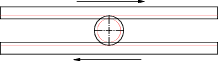
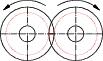

A mechanism capable of delivering output motion in either direction can also be achieved using pneumatic and hydraulic systems with appropriate direction control valves. A lever or gear type system would require the use of some type of clutch. Some two-way clutches which connect one output shaft to one of two drive shafts rotating in the opposite directions can result in a direction reversal of the output shaft without stopping the drive shaft. This, of course assumes no problems due to inertia.
Rotational Couplings / Connectors
Transmitting motion between parallel, coaxial, intersecting and skewed shafts is achieved using mechanical coupling systems. There are a wide range of different designs of couplings. The basic simple design of coupling is used to transmit rotary motion in both directions between two co-axial shaft. The design of these couplings is based on the torque to be transmitted, the speed, and the degree of misalignment..
The available range of gear designs can be used to connect shafts of virtually any relative orientation. Gears not only allow the transfer of rotation but also direction and speed.
Belt drives can also be used to couple shafts together. The method can accomodate various relative shaft positions and can be designed such that the relative shaft positions can vary as rotation is taking place.
Chain drives provide more positive coupling than belt drives but are not as positive as gear drives..
Typical couplings based on simple link systems are shown below. These methods are limited in the power that can be transmitted and the evenness of the output shaft motion.
|
|
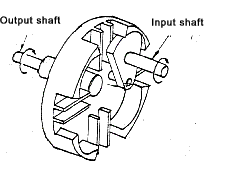 Realeaux Coupling |
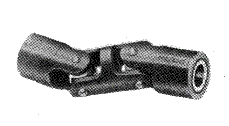
Sliding Connectors
Sliding connectors are used when one slider is used to drive another slider. The normal problem is that the sliders operate on the same plane but in different directions..Different methods of solving this problem include.
|
|
|
|
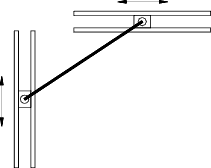
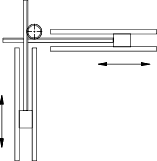
Stop and Dwell Mechanisms
The most obvious example of this type of mechanism is that used to control the valves on and internal combustion engine. The valve has to open, remain open for a fixed part of the cycle, close, and remain close for a fixed part of the cycle. The solution for this type of mechanism is to use of cam controlling the motion of the valve stem.
Indexing mechanisms as described in the indexing section can often provide stop and dwell motions.
Curve Generators
The four bar chain can be used to generate an infinite range of curves by adjusting the two fixed pivot points and the lengths of the links. The curves generated by the free pivot points are obviously circles with radii = to the length of the links to the adjacent fixed pivot points. The motion of points along the coupler between the two free pivot points is however complex and variable.
The modern method of developing curve motion is to use Numerical control methods combined with hydraulic, or electronic servo drives. There are however opportunities for using direct mechanical systems for low cost components.
Straight Line Generators
The clear obvious method of developing a straight line motion is to use a machined slideway. The obvious alternative method is to use computer controlled electric or hydraulic drive systems. However in the early days of the engineering industry these options were not available and methods of generating straight lines using linkages were developed. These systems all resulted in approximate straight lines but they were generally sufficient for the requirements.
|
|
|
< |
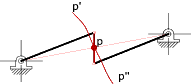 Whitworth Straight Line Mechanism
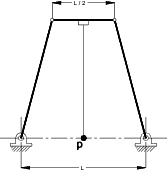 Roberts Straight Line Mechanism
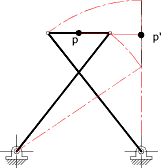 Chebychev Straight Line Mechanism
Path Following Mechananisms
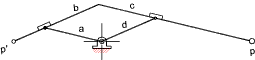
The pantograph (ref figure below) is a linkage mechanism that is used to trace the movement of a point at a larger or small scale. Movement of point p is copied by movement of point p'. The geometric requirement of the pantagraph linkage are that the links a,b,c & d form an equal sided parallelogram.