The notes on this page are provided to simply describe convolutions and their application with respect to Continuous Fourier Transforms and Discrete Fourier Transforms.
Mathematically, a convolution of two function f1( x ) and f2( x ) is defined as the integral over all space of the product of one function at f1( u ) and another function at f1( x - u ). (The variable x being substituted by u) The convolution operation is illustrated below. The * is used to indicate the convolution operation.

Note: f1 ( x ) * f2 ( x ) = f2 ( x ) * f1 ( x )
The convolution process is completed in four steps as illustrated in the figure below
1 ) Obtain f2 ( - u ).
2 ) Obtain f2 ( x - u ).
3 ) Consider all possible cases of x from  .
.
Calculate the producti f1 ( u ). f2 ( x - u ) when they both have values
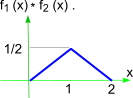
4 ) Determine the integral.
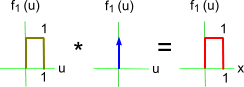
The process is illustrated by a very simple example. two simple example function f1 ( u ) and f2 ( u ) are shown below

1 ) Obtain f2 (-u). 2) Obtain f2 ( x - u ).
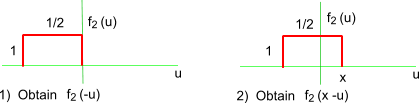
3 ) Consider all possible cases of x from . Calculating the producti f1 ( u ). f2 ( x - u ).
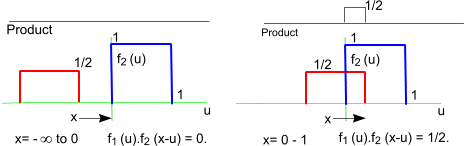
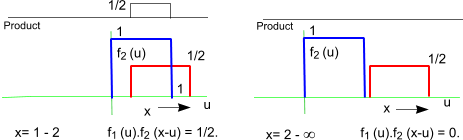
4 ) Plot of the integral . This is the integral of the product of the overlapping part of the two functions.
Convolution process with f1 ( u ) = 1 and f2 ( u ) = e -u

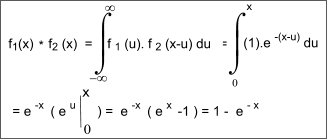


An illustration is provided below of the convolution of a one four point input signal x(n) with an eight point response h(n) resulting in a 4+8-1 = 11 point output signal. y(n)
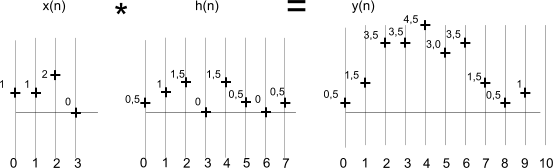
The above output signal is effectively the sum of four seperate signal responses x(0)*h(0) + x(1)*h(n-1) + x(2)*h(n-2) + x(3)*h(n-3). In mathematical terms, x(n) is convolved with h(n) to produce y(n) . Each of the four samples in the input signal contributes a scaled and shifted version of the impulse response to the output signal. The four versions are shown below.
At x(0) the signal value = 1 is decomposed into an impulse δ(0) and the resulting output signal = 1.h(0). That is the contribution is the response scaled by 1 and unshifted.
At x(2) the signal value = 2 is decomposed into an impulse 2.δ(n-2) and the resulting signal output signal = 2.h(n-2). That is the contribution is the response scaled by 2 and shifted 2 to the right
