In many factories in the past flat belts have been widely used to drive the machines in the factories. They are convenient to install and operate and are reliable. In modern times machines are driven individually generally using electric or hydraulic drives...
Flat belt drives are now mostly used for low power high speed applications in specialised industries including the textile, paper making, and in office machinery. Flat belts are also used for conveyor applications.
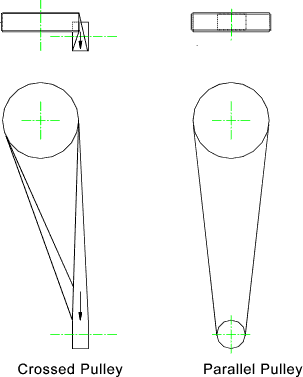
|
In the past belts were generally made from leather. Now belts are also manufactured from a wide range of elastomer including urethane, neoprene, hypalon, EPDM, and silicone. Stretch, semi-stretch, and no-stretch belts are available. Belts are often reinforced with textiles and fibres and and metal reinforced belts are available. Belts can be provided with durable surface coatings and coatings providing anti-static properties
When designing belt drives it is normal to apply a service factor to the drive operating load to compensate for allow for different driver type, driven load types and operating periods. Typical ervice factor values are included on the linked page Service Factors
| Fc = Centrifugal Force (N) R = Pulley reaction Force (N) P = Max power transferred kW T = Belt tension Tc = Belt tension due to centrifugal force μ = Coefficient of Friction. b = Belt width (m) ω = Angular velocity of pulley (rad/s) n = Rotational Speed (RPM) θ = Angle of belt lap v = Linear velocity of belt (m/s) |
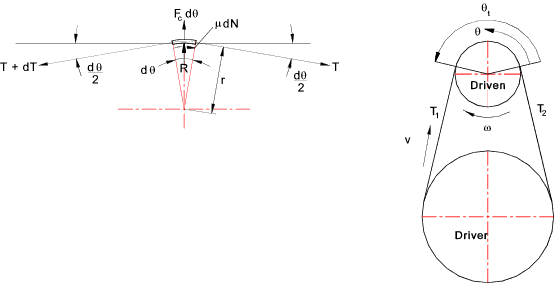
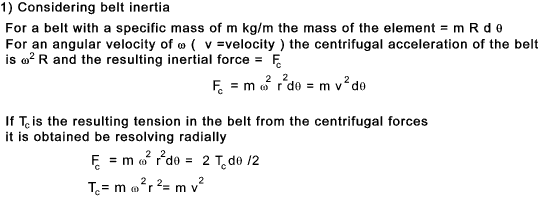
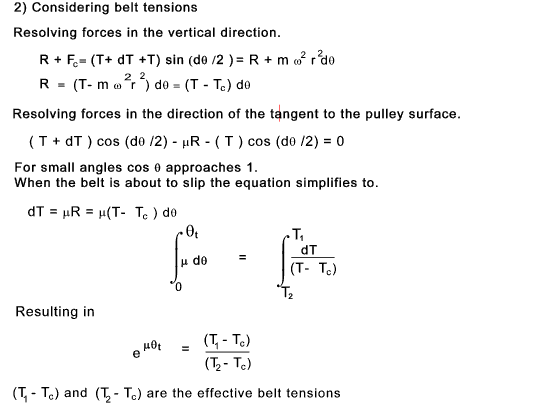
Note: If two pulleys of different diameters are used then in driving to the limit the belt will slip on the smaller pulley first
The power transferred =
P = (T1 - T2 ).v / 1000
= (T1 - Tc) - (T2 - T c ).v / 1000
= (T1 - T2 ) (1 - e-μθ ).v /1000
Belt Friction Factors
| Material Combination |
Lubrication | Coefficient of Friction (μ) |
| Leather on Wood | Lubricated | 0,47 |
| Leather on Cast Iron | Good Lubrication | 0,12 |
| Leather on Cast Iron | Low Lubrication | 0,38 |
| Steel Band on Cast Iron | Dry | 0,18 |