There are two general types of reciprocating pumps. The piston pump and the diaphragm pump.
These types of pump operate by using a reciprocating piston or diaphragm. The liquid enters a pumping chamber via an inlet valve and is pushed out via a outlet valve by the action of the piston or diaphragm.
Reciprocating pumps are generally very efficient and are suitable for very high heads at low flows.
This type of pump is self priming as it can draw liquid from a level below the suction flange even if the suction pipe is not evacuated.
The pump delivers reliable discharge flows and is often used for metering duties delivering accurate quantities of fluid.
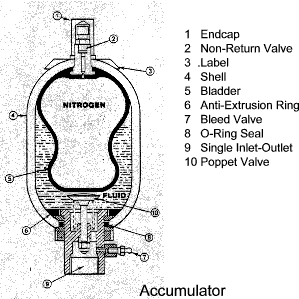
The reciprocating pump is not tolerant to solid particles (See notes below on air operated diaphragm pumps) and delivers a highly pulsed flow. If a smooth flow is required then the discharge flow system has to include additional features such as accumulators to provide even flows.
Reciprocating pumps designed for delivering high pressures must include methods for releasing excessive fluid pressures. The pumps should include for built in relief valves or relief valves should be included in the fluid circuit which cannot be isolated from the pump. This feature is not required for safety for the air operated diaphragm valve.
Piston Pumps /Plunger pumps
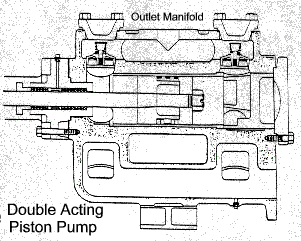
A piston pump can be based on a single piston or, more likely, multiple parallel pistons. The pistons are reciprocated using cams or crankshafts. The stroke is generally adjustable. This type of pump can deliver heads of up to 1000 bar. The largest sizes of piston pumps can deliver flows of 40m3 /hr. In practice these pumps are more likely to be used for metering low flow rate fluids at more modest pressures in laboratories and chemical process plants. Piston pumps are not generally suitable for transferring toxic or explosive media.
Note: This description does not refer to the rotary piston pump as described in on the page on Rotary Positive Displacement Pumps... Rotary Positive Displacement Pums
There are two types of diaphragm pumps. The hydraulically operated diaphragm metering pumps and the air actuated type.
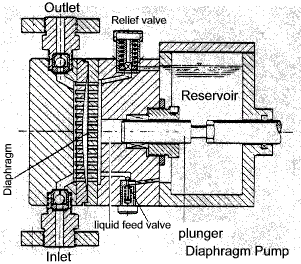
The hydraulically operated diaphragm metering pump is used for similar duties as the piston pump. It has some significant advantages compared to the piston pump in that the design does not require glands or piston seals The diaphragm in the hydraulically operated diaphragm pump shown below is actuated using a plunger pump arrangement. This provides full support of the diaphragm allowing high pressure operation. The pump can include for duplex diaphragms with the interface being monitored for failure of the diaphragm in contact with the fluid. This type of pump can be used for pumping toxic and explosive fluids. The pump can deliver heads of up to 700 bar and transfer flows of up 20 m 3 /hr. These pumps require continuous monotoring as the diaphram is under high fatigue loading and the inlet and outlet valves are subject to erosion and blocking. Under a high quality maintenance regime these pumps are very reliable.
Air Operated Pump
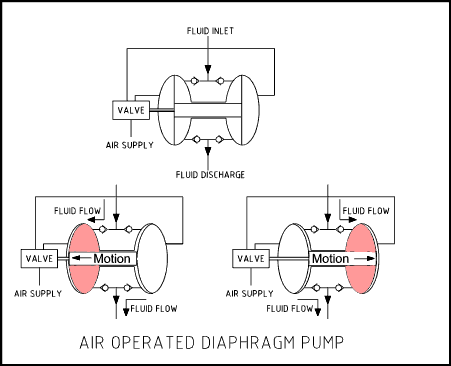
The air operated pump is generally a low cost work horse pump used for transferring any type of liquid including sludge. The inlet and outlet valves are often low cost easily replaced flap or ball valves. The pump is comprises two circular chambers each split by a large elastomeric diaphagm. The two diaphragm centres are mechanically coupled together with a shaft. An interlocked valve admits air pressure to one side of one of the chambers and exhaust the air from the opposite side of the other chamber. This causes both diaphagms to move. One diaphragm pushing fluid out through a non return valve. The other diaphragm drawing fluid in through a non return valve. On completion of a full stroke the valve reverses the air supply and exhaust directions causing the diaphragms to move back. The diaphragm which was pushing fluid out of the pump now sucks fluid and the diaphragm admitting fluid now pushes fluid out. The system is therefore double acting.
The pump capacity is limited by the air pressure available (generally 7 bar) and the design of the diaphragm. An elastomeric diaphragm has a limited life and will only operate for a few million cycles. A flow rate of about 40 m3 /hr is a reasonable maximum achievable flow with a larger pump.
For any air operated diaphragam pump the higher the flow the lower the discharge head possible.